


KBC Prime Edition Interview with Dr John Ndavula
Calls for inclusive disability representation in media during CAMRED launch
Dr John Ndavula, a Senior Lecturer at Murang’a University of Technology (MUT), has called on Kenyan media organisations to rethink how they portray People with Disabilities, emphasising the need for respectful language, diverse storytelling, and greater inclusion in media production.
Speaking during an interview on Kenya Broadcasting Corporation’s (KBC’s) television Prime Edition on 7 April 2026, Dr Ndavula observed that People with Disabilities remain underrepresented in Kenyan media despite being an important part of society.
The media is a mirror of society. If we do not see People with Disabilities represented in the media, yet they are part of our society, then there is a disconnect between what we see in the media and the reality on the ground.
Dr John Ndavula
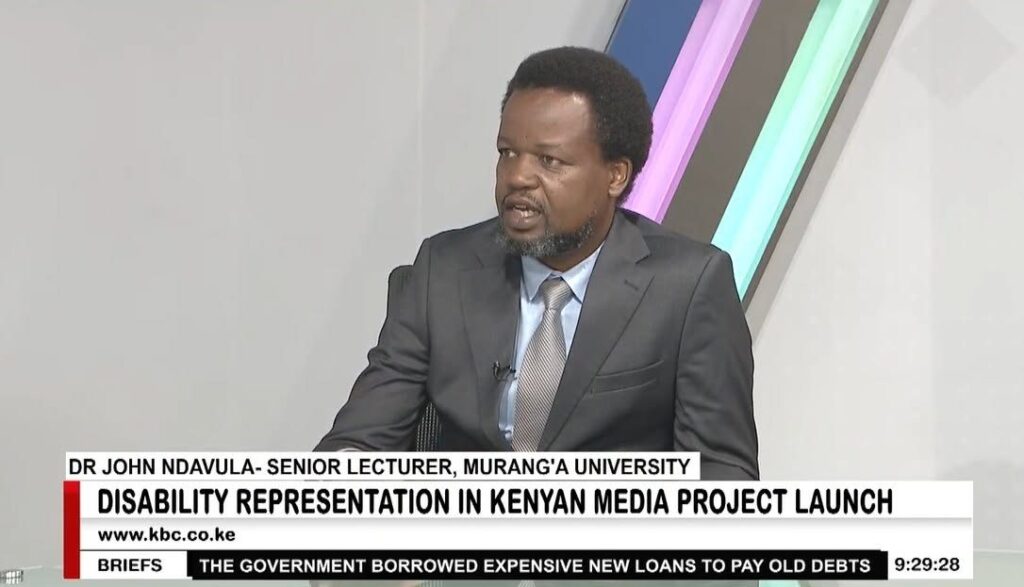
The interview followed a roundtable discussion that brought together researchers, journalists, disability advocates, and media practitioners as part of the launch activities for the Changing Attitudes through Media Representations of Disability (CAMRED) research project.
The project brings together Murang’a University of Technology, African Nazarene University, and Bournemouth University in the United Kingdom, alongside media organisations and disability advocacy groups. Among the participating organisations are the Kenya Broadcasting Corporation (KBC), Signs TV, and the Action Network for the Disabled (ANDY).
Changing how disability stories are told
Dr Ndavula noted that disability coverage in Kenyan media has frequently relied on narratives that portray People with Disabilities as objects of pity or charity rather than as active members of society.
He explained that such portrayals can reinforce stereotypes and contribute to the continued marginalisation of People with Disabilities.
The CAMRED project seeks to address these challenges by bringing together researchers, media practitioners, and disability advocates to develop practical approaches to disability representation.
A key planned output of the project is a media reporting toolkit that will guide journalists and content producers on appropriate terminology, story framing, and inclusive reporting practices.
The toolkit will be co-created with media professionals, researchers, and organisations of People with Disabilities to ensure that it responds to the practical needs of newsrooms.
Language matters in disability reporting
One of the key issues discussed during the interview was the language journalists use when referring to People with Disabilities.
Dr Ndavula encouraged journalists to adopt people-first language and avoid expressions that reinforce negative stereotypes.
For example, he advised journalists to use the term “wheelchair user” rather than “wheelchair-bound”, explaining that the latter wrongly portrays a wheelchair as a restriction rather than a mobility aid.
He also encouraged media practitioners to use the term “People with Disabilities” instead of expressions such as “people living with disabilities” or “differently abled”.
First of all, you have to look at people first.
Dr John Ndavula
He further urged journalists to develop stories that reflect the different roles People with Disabilities play in society, including as professionals, political leaders, entrepreneurs, and community members.
From research to practical solutions
Dr Ndavula explained that the CAMRED project provides an opportunity to translate academic research into practical interventions that can improve media reporting.
Through collaboration with journalists, media producers, and disability advocates, the research team intends to identify effective approaches to disability representation and incorporate them into newsroom practices.
He noted that while existing legislation, including the Persons with Disabilities Act, 2025, provides a framework for inclusion, journalists also require practical guidance on implementing inclusive reporting.
The project therefore seeks to bridge the gap between research, policy, and everyday media production.
Inclusive journalism training
During the interview, Dr Ndavula highlighted Murang’a University of Technology’s contribution to inclusive journalism through its journalism training programme.
He explained that the University offers a fourth-year unit in Disability Reporting, which combines classroom learning with practical projects.
Students are introduced to disability reporting concepts, interact with guest speakers, and undertake media production assignments that allow them to apply inclusive reporting principles.
According to Dr Ndavula, graduates who have undertaken this training are already contributing to disability-related journalism in Kenyan media houses, with some working as disability reporters and others developing programmes focusing on disability issues.
He emphasised that integrating disability reporting into university curricula is an important step towards preparing journalists who can report on disability accurately and respectfully.
Recommendations for Kenyan newsrooms
Concluding the interview, Dr Ndavula outlined three immediate actions media organisations can take to improve disability representation.
- Journalists should use accurate and respectful language that does not perpetuate stereotypes or stigma.
- Newsrooms should explore diverse story angles that portray People with Disabilities beyond the conventional narratives of vulnerability, dependence, and charity.
- Media organisations should strengthen collaboration with organisations of People with Disabilities and involve individuals with disabilities directly in developing and telling their stories.
He emphasised that meaningful inclusion requires moving beyond occasional disability-focused coverage to making disability representation part of routine media practice. The year-long CAMRED project hopes to improve how disability is represented in the media in Kenya.